
We Become Ourselves Through Each Other
What Stefan Merrill Block's memoir about isolation taught me about connection, creativity, and the only strategy that actually works

(There’s a treat at the bottom 🫣 🎸)
Hi!
On last week’s episode of Dinner Last Night, Stefan Merrill Block took us deeper behind his memoir Homeschooled, a searingly honest account of the years he spent in isolation, homeschooled by a mother whose love was fierce and quietly suffocating.
His isolation wasn’t just physically lonely. It was the experience of having his world defined entirely by one person’s vision. As Stefan writes: “Everyone else’s story has other people. Without other people, what story, what kind of book-worthy life, can I ever hope for?”
What struck me most is that his healing didn’t come through achievement, though he tried to fill the void by excelling at science fair competitions. He began to heal by rebuilding connection: with Mama Shep, his sympathetic teacher and mentor; with friends at college; with his wife, who shared a resonant childhood experience; and with his children, for whom he is now inventing new traditions at his own table.
Stefan didn’t find himself by manifesting a vision board. He found himself by showing up for other people, and letting them show up for him.
His memoir keeps circling back to this: we need each other in order to become ourselves. Not despite each other. Through each other.
The book is about what it costs when that negotiation collapses in one direction. Too much self. No table.
I’ve been thinking about that in the context of something that’s been nagging at me on Substack.
Substack was supposed to be different. A return to writing, to voice, to the slow and genuine connection that unfolds when we share intimately with one another. And in many ways it is. But scroll through Notes on any given day and you’ll find that a significant portion of what goes viral is about how to go viral, how to grow, and how to monetize. Success culture followed us right into Substack and made itself right at home.
Maybe this is just the nature of online social platforms.
And I’m certainly not immune to it. I notice myself wondering: Should I be posting more? Should my notes be punchier? Am I leaving subscribers on the table? I start to follow whatever roadmap the latest authority on Substack has released, only to find myself overwhelmed and out of alignment with how I want to show up in my work and in the world.
And that’s because online success culture demands hyper-individualization over honest, dare I say, “real life” connections, which not only feel good, but are integral to human life.
I’ve been thinking about a recent conversation with Cat Seixas, one of my favorite humans and friends online, and writer of The Olive Trees and the Moon. She told me she originally got on Instagram for one reason: to connect with people doing something similar, so she could learn from them and share her progress. When Instagram became diluted with ads and algorithms, she moved to Substack for the same reason; to connect. She doesn’t have a content strategy. She doesn’t post on a schedule engineered for reach. What she has is an authentic voice and genuine curiosity about the people following her work. And her notes go viral anyway.
I think what Cat is doing, without calling it this, is the original vision of Kevin Kelly’s 1,000 true fans. You don’t need millions of followers. You need a thousand people who genuinely love what you do, and, who you want to support. And you cannot manufacture that. The relationship has to come first.
This is a logic we already know intimately, from healthy family life. We just forget to apply it anywhere else.
Every family runs on negotiation. Whose dream do we follow this year, or in this moment? Whose needs take the front seat? How do we hold all of it while honoring each person at the table?
My daughter came home with a Mother’s Day worksheet. Under “my mother always says,” she wrote: teamwork makes the dream work. It’s been on the chalkboard in our mudroom for years, and apparently it landed.
But some dreams are harder to negotiate than others.
Moving to Italy has always been one of mine. I yearn for the slower rhythms, the chance to speak my mother’s tongue daily, the way food is rooted there. It is a life I can see clearly for myself, and for my family.
And, my children don’t want that. Home, for them, is where their cousins and friends are, where they can speak their primary language, where they can snuggle their pets. Their roots are here, and those roots are real and worth honoring. And those roots are also essential for me.
So while we did plan a multi-month world-schooling trip in Italy (which I’m writing about here), we aren’t moving there. My dream hasn’t disappeared. It just has to be held differently, in relation to people I love. Maybe Italy happens in shorter, more deliberate trips. Maybe work takes me there more consistently. The shape of it changes.
But the act of negotiating it, of holding my own longing alongside the needs of my family, is the work of a shared life.
Compromise not as defeat, but as love. You don’t get everything you want at the dinner table. You get something better, if you’re lucky: a table worth sitting at.
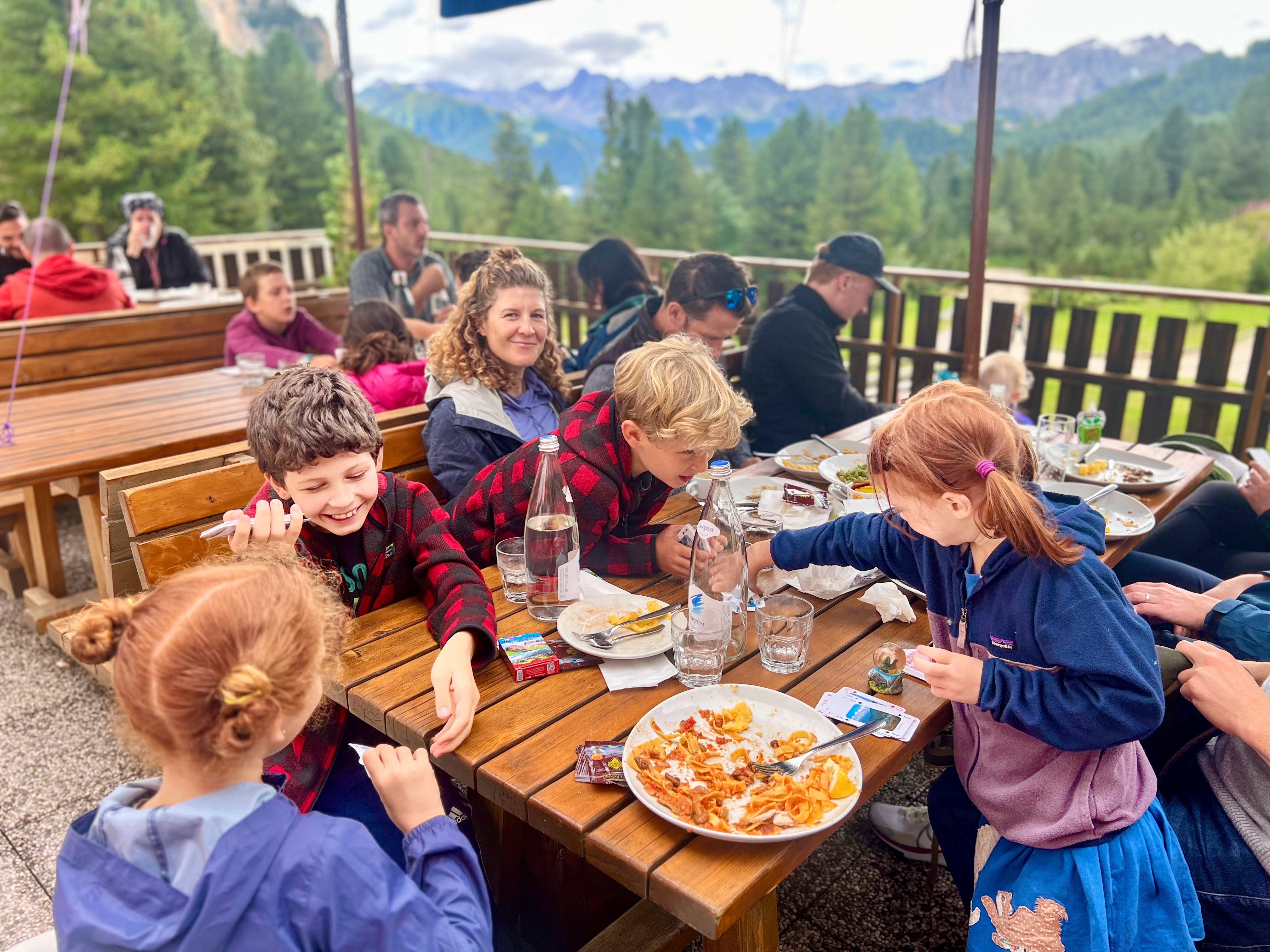
What I’m starting to believe is that this same negotiation, the one we can practice at home, is the one we’re supposed to be having as entrepreneurs, writers, creators.
Not: What is my vision and how do I execute it?
But: Who is already at my table, and what do they need from me, and what do I need from them, and how do we build something together?
Stefan is living this quietly in his own work: new traditions at his family table, a roller rink in the Hudson Valley where people come to find joy together, books that crack open the silences families carry so readers can finally name their own. He’s not dominating an algorithm. He’s making things people love because they feel true, and because they invite connection.
Before we left for Europe, my spiritual mentor, Mirah Love, sent me a letter explaining what she had come to understand after years of practice with her teacher: the most important thing we could learn wasn’t meditation techniques or discipline, or even wisdom.
It was loving connection.
I’ve been thinking about that letter ever since. About what it means to run a creative life the way a healthy family constellation shows up at the dinner table, with everyone’s hunger accounted for, with room for unexpected feelings or guests, and with the understanding that the meal is not the point.
The people present are.
I've noticed this in my own work. “Likes” are a far less meaningful metric to me than the text message from a friend telling me how a recent podcast episode helped them learn about a new trick to address picky eating, the email reply from an old friend who has been considering a world-schooling trip or move, or the conversation with a stranger in the produce section of the grocery store about how I'd prepare artichokes.
Not a number. A relationship.
That’s the only strategy I’m interested in.
This past year I started writing songs and re-learning guitar. Last night I played at my first music open mic at the sweetest little market run by my friend Karthik, Danby Food + Drink. This song started as a note to myself: there’s enough room for everyone. If I catch you, will you catch me too.
I’m curious if you also have a dream you're holding differently right now (or in the past), in relation to the people you love? I'd love to know in the comments. 👇
🌸 With my nose in the lilac blossoms,
E
My husband pointed out that my daughter’s worksheet actually said: “teawork makes the dream work.” That too! Lol.